The quest for natural skincare often leads us to the most challenging of all DIY projects: sun protection. For many home formulators, the idea of a DIY zinc oxide sunscreen is incredibly appealing. It promises a mineral-based alternative to chemical filters, free from synthetic preservatives and packaged in a way that aligns with a low-waste lifestyle. However, creating an effective sun barrier at home is not as simple as mixing a few oils with a mineral powder. It requires a deep understanding of how UV filters work, the limitations of home manufacturing, and most importantly, a commitment to safety.
In the world of natural skincare, zinc oxide stands out as a hero ingredient. Unlike chemical sunscreens that absorb UV rays and convert them into heat, zinc oxide acts as a physical shield, reflecting and scattering light away from the skin. It is widely considered the gold standard for natural sun care because of its broad-spectrum capabilities, covering both UVA and UVB rays. If you have ever wondered whether you can truly make a reliable DIY zinc oxide sunscreen in your own kitchen, this guide will walk you through the science, the safety considerations, and a basic formulation for educational use.
The Science Behind DIY Zinc Oxide Sunscreen
To understand why we use zinc oxide in homemade formulations, we first need to look at how it interacts with the sun. Zinc oxide is a mineral that has been used for centuries in various medicinal and cosmetic applications. When applied to the skin, it provides a physical barrier that is effective immediately upon application. This is a significant advantage over chemical filters, which often require twenty minutes to “set” before they provide full protection. When formulating a DIY zinc oxide sunscreen, this instant protection is one of the most attractive features for beginners.
Zinc oxide is particularly valued because it is one of the few ingredients that offers true broad-spectrum protection. This means it protects against UVB rays, which cause surface sunburn, and UVA rays, which contribute to premature ageing and long-term damage. While titanium dioxide is another popular mineral filter, it is generally less effective at blocking long-wave UVA rays compared to zinc oxide. For this reason, most natural formulators focus on a DIY zinc oxide sunscreen as their primary project for sun care, as it provides a more comprehensive shield against the full spectrum of solar radiation.
However, the effectiveness of any DIY zinc oxide sunscreen depends heavily on its dispersion. In a laboratory setting, high-shear mixers ensure that the zinc particles are perfectly distributed. If the particles clump together, they leave “holes” in the physical barrier, allowing UV rays to reach the skin. This is the primary challenge for the home formulator, as manual stirring or basic kitchen blenders cannot always achieve the same level of microscopic dispersion found in commercial products. Ensuring a smooth, even mix is the key to a successful DIY zinc oxide sunscreen.
Critical Safety Disclaimer: Know the Limits
Before we dive into any recipes, it is vital to address the elephant in the room: safety. While making your own moisturiser or lip balm is relatively low-risk, sun protection is a matter of health. Commercial sunscreens are classified as therapeutic goods in Australia and are subject to rigorous testing. This includes SPF testing on human volunteers and stability testing to ensure the product does not separate in the heat. A DIY zinc oxide sunscreen lacks this professional validation, which is why caution is paramount.
A DIY zinc oxide sunscreen cannot be accurately tested for its SPF (Sun Protection Factor) at home. Even if you follow a recipe that claims to be SPF 30, there is no way to verify that your specific batch provides that level of protection. Factors such as the quality of your zinc oxide, how well you mixed it, and even the temperature of your oils can all affect the final result. Because of this, a homemade DIY zinc oxide sunscreen should never be used as your primary protection for prolonged sun exposure, such as a day at the beach or a long hike.
Instead, we recommend using a DIY zinc oxide sunscreen for incidental sun exposure only. This includes short walks to the car, hanging out the washing, or sitting near a window. For high-intensity sun, always rely on a TGA-approved, commercially tested sunscreen. Think of your DIY zinc oxide sunscreen as a secondary layer of protection or a way to add mineral benefits to your daily moisturiser, rather than a total replacement for professional sun care products.
Uncoated vs Coated Zinc Oxide: Which Is Better?
When shopping for ingredients for your DIY zinc oxide sunscreen, you will likely encounter two main types of zinc oxide: uncoated and coated. Understanding the difference is crucial for both the performance and the feel of your final product. Both options are common in a DIY zinc oxide sunscreen, but they offer different application experiences.
Uncoated zinc oxide is the most natural form, simply the mineral powder in its raw state. While effective, it can be difficult to stir into oils and often results in a heavier white cast. It can also be slightly more reactive with other ingredients, though it remains safe for topical use. Many purists prefer uncoated zinc for their DIY zinc oxide sunscreen because it contains no additional synthetic coatings or processing agents.
Coated zinc oxide has been treated with a substance like dimethicone or stearic acid. This coating makes the zinc “hydrophobic,” meaning it repels water and mixes much more easily into oils. Coated zinc typically offers a smoother application, better dispersion, and a reduced white cast. For a more professional-feeling DIY zinc oxide sunscreen, coated zinc is often the preferred choice among intermediate formulators who want a more elegant skin feel.
Regardless of which type you choose for your DIY zinc oxide sunscreen, always ensure you are using “non-nano” zinc oxide. Nano-sized particles are small enough to potentially enter the bloodstream, whereas non-nano particles are larger and stay safely on the surface where they can do their job of reflecting UV rays without being absorbed into the body.
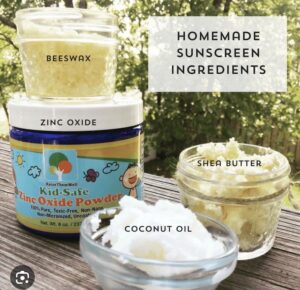
Educational Recipe: Basic DIY Zinc Oxide Sunscreen
This recipe is intended for educational purposes to help you understand the mechanics of mineral sun care. It uses a 20% concentration of zinc oxide, which theoretically provides protection in the SPF 15 to 20 range, though this cannot be guaranteed without professional testing. This is a classic starting point for anyone learning how to formulate a DIY zinc oxide sunscreen.
Ingredients
- Zinc Oxide (Non-Nano): 20g (20%)
- Shea Butter: 30g (30%)
- Coconut Oil: 35g (35%)
- Beeswax Pellets: 14g (14%)
- Vitamin E Oil: 1g (1%)
Step-by-Step Instructions
- Prepare your workspace: Ensure all your tools and containers are clean and dry. Use a digital scale for accurate measurements when making your DIY zinc oxide sunscreen.
- Melt the base: In a double boiler over low heat, combine the shea butter, coconut oil, and beeswax pellets. Stir gently until everything has completely melted into a clear liquid.
- Cool slightly: Remove the mixture from the heat and let it cool for a few minutes. You want it to remain liquid but not be piping hot when you add the active ingredients to your DIY zinc oxide sunscreen base.
- Add the zinc oxide: Carefully add the zinc oxide powder to the oil mixture. Wear a mask during this step to avoid inhaling the fine powder.
- Mix thoroughly: This is the most critical step in creating a DIY zinc oxide sunscreen. Use a small whisk or a battery-operated milk frother to blend the zinc oxide into the oils. Continue mixing for several minutes to ensure there are no clumps and the powder is evenly dispersed.
- Add Vitamin E: Stir in the Vitamin E oil, which acts as an antioxidant to help preserve the shelf life of the oils in your DIY zinc oxide sunscreen.
- Pour and set: Pour the mixture into a clean glass jar or a tin. Let it sit undisturbed at room temperature until it has fully solidified.
How to Use Your Homemade Blend
Apply your DIY zinc oxide sunscreen generously to any exposed skin. Because this is a physical blocker, you will see a white layer initially. Rub it in well until the white cast diminishes. Remember to reapply every two hours, especially if you are perspiring, as this formula is not fully waterproof and needs frequent touch-ups to maintain its effectiveness.
Managing the Infamous White Cast
One of the biggest complaints about any DIY zinc oxide sunscreen is the white cast it leaves on the skin. Because zinc oxide is a white pigment, it naturally reflects light, which can make you look a bit like a ghost if not formulated correctly. This is particularly noticeable on darker skin tones and can be a deterrent for many people considering a DIY zinc oxide sunscreen.
To reduce the white cast in your DIY zinc oxide sunscreen, ensure you are using the best possible dispersion method. The better the zinc is mixed, the less it will clump and the more transparent it will appear. Using coated zinc oxide also helps significantly with transparency. Another trick is to add a tiny amount of natural pigment to your recipe. A pinch of cocoa powder or a small amount of iron oxide can help tint the cream to match your skin tone, turning your DIY zinc oxide sunscreen into a tinted moisturiser that blends seamlessly.
It is also important to remember that a slight white cast is actually a good sign for a DIY zinc oxide sunscreen. It shows that the mineral is present on the surface of your skin and is ready to reflect UV rays. In the world of natural sun care, that white glow is often seen as a mark of safety and purity, proving that you have applied enough product to provide a physical barrier.
Pro Tips for Better Formulations
If you are looking to take your DIY zinc oxide sunscreen to the next level, consider the storage of your sunscreen. Because this recipe contains no water, it does not strictly require a broad-spectrum preservative, but the oils can still go rancid. Keep your jar in a cool, dark place and avoid leaving it in a hot car, as the heat can cause the beeswax to melt and the zinc to settle at the bottom of your DIY zinc oxide sunscreen container.
Another tip is to experiment with different carrier oils in your DIY zinc oxide sunscreen. While coconut oil is a classic choice, some people find it too greasy or comedogenic. You could substitute part of the coconut oil for red raspberry seed oil or carrot seed oil. While these oils are often touted as having their own SPF, their actual protection is very low and inconsistent, so they should only be used as carriers for the zinc, not as stand-alone sunscreens.
Finally, always perform a patch test before using your DIY zinc oxide sunscreen. Even natural ingredients can cause irritation, especially when used in high concentrations like the zinc oxide in this formula. Apply a small amount to your inner arm and wait 24 hours to ensure you don’t have a reaction before applying it more broadly to your face or body.
Safety and Stability Checklist
- Always use non-nano, pharmaceutical-grade zinc oxide in your DIY zinc oxide sunscreen.
- Wear a dust mask when handling zinc powder to protect your lungs.
- Never use your DIY zinc oxide sunscreen on broken or irritated skin.
- If the mixture separates or smells “off,” discard it immediately and make a fresh batch.
- [Learn more about carrier oils](INTERNAL_LINK) to find the best base for your skin type.
- Check out our guide on [natural preservatives](INTERNAL_LINK) if you decide to add water-based ingredients like aloe vera to your formula.
The Future of Your Sun Care Routine
Embracing a DIY zinc oxide sunscreen is a wonderful way to connect with the ingredients you put on your body. It empowers you to avoid chemicals you may be concerned about and allows you to customise your skincare to your exact needs. However, it also comes with the responsibility of understanding the limitations of home-crafted protection. A DIY zinc oxide sunscreen is a tool in your natural beauty arsenal, but it must be used wisely.
As you continue your journey in DIY skincare, you might find that you enjoy using your homemade zinc cream as a daily face balm, while keeping a high-quality, mineral-based commercial sunscreen for those long days in the Australian sun. This balanced approach ensures you get the best of both worlds: the joy of creating your own DIY zinc oxide sunscreen and the peace of mind that comes with proven, tested protection. For more inspiration on natural sun care, explore our [DIY after-sun soothing gel](INTERNAL_LINK) recipe to keep your skin hydrated after a day outdoors.
By focusing on high-quality ingredients like non-nano zinc oxide and nourishing butters, you can create a beautiful, functional product that supports your skin’s health. Just remember to stay sun-smart: wear a hat, seek shade, and always respect the power of the sun. Your DIY zinc oxide sunscreen is just one part of a comprehensive sun safety strategy.
You May Also Like